Ideas through brain storming…
simple tips...
1. Avoid direct sunlight exposure by wrapping your self light color preferably white cotton cloth
2. Where ever possible carry water bottle with sprinkler and moist your back of neck, and face and ear lobes by sprinkling water as it will help in keeping these most temperature sensitive parts at lower temprature. This will make you feel cooler preveent sun stroke
3. Use dark color polarized uv protected sunglass this will help your eyes protected from harmful uv radiation as well as from glare. it wil also make u feel cooler
4. Use large rim hat this will prevent direct sunlight striking your face.
5. Do not leave a fan on in an enclosed room when no one is present. A fan does not cool the air already in the room; in fact, it heats it. The fan's motor generates heat and even the circulating air creates a significant amount of heat from friction. It just feels cooler when you are present because of natural moisture evaporation from the skin, which only cools your body if you are in the room. Save electricity and turn off all fans in enclosed rooms that are not occupied
little complicated tips...

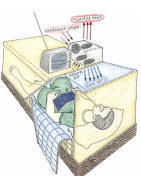
1. An interesting concept is to provide a comfortable, air-conditioned environment in a limited space for sleeping comfort. It saves the energy cost of needlessly air-conditioning a large space when your are only occupying a small space. The same idea could be used for the heating season with a small heater in the bed cubby. no wonder one can reduce heat load to 80%
2. in hot climates sleeping directly on the water bed bladder will be cooler. Remove all the coverings except for a sheet or two, and let the water conduct heat away from your body.
3. Roof being the major source for indirect heating of room.
a. Use Roof sprinkler system it will reduce cooling bills by keeping the roof cooler through water evaporation.
b. spread guny bag and moist it with water. This will help in keeping temprerature of roof cooler
c. Make thick carpet rolls from old news paper. Spread them over the roof in day time and roll back in evening.
d. Arrange false roofing over the roof to creat enough gape for air circulation this will reduce roof temperature considerably
e. Use exhaust fan installed near the roof to remove hot air from room.
f. Avoid ceiling fan in room located on top floors, as it will circulate air which is already heated by heated roof. all over the room. Instead of that use pedestal fan at low RPM just enough to evaporate sweat from from us, as evaporation of sweat takes heat from our body.
g. force hot air on top floor as it and use pedestal fan
4. Most temprature sensitive parts in our body are 1. ear lobes, 2. neck, 3. feet, 4. wrist. 5. head. so if you are not able to cool down whole body to a comfortable temperature then make sure that at least these body surface are cooler. This can also save u from sun stroke.
5. While it is rarely a problem for individuals with good health due to over-hydration, but it is a possibility for individuals with heart, liver or kidney problems. If you have any serious health problems, be mindful of how much water you drink, since your kidneys may not be able to excrete an excessive amount of water properly.
6. Never leave children or pets in cars alone for any amount of time.
7. Babies, children, pregnant women, and the elderly are all much more prone to overheating than others. Be sure to keep an eye on members of your family, co-workers, and neighbors. Also, as you age, your body does not regulate temperature as well as it used to (even if you stay fit) and your skin may not be able to sweat. Be cautious and see if you can relax in an air-conditioned place for a while.
8. Heat is often the uncomfortable companion of drought. If there are water restrictions in your area, make sure you consider them before implementing any of the water-intensive suggestions like coolers and sprinklers.
9. In low humidity and water scare area houses are design to take advantage of difference in day and night temperature. Room construction is done with thick walls and material using low heat conductivity with no or very small windows, windows and doors are kept closed in day time when out side temprature is higher , and windows are open in night when outside temprature is lower.
these construction have small opening at roof top which regulates the air flow. It is closed in day time and kept open in night.
when out side ambient temperature is high due to bright sun light. Thick wall stop heat to enter in to the room and in night time when ouside temperature is low the opening on top of the roof is open so that outside cold air enter in to the room through doors and hot air in room leaves from the roof top opening. this type of construction is adopted in deserts . wall thickness can be as high as 2 meter. Made up of sand and mud.
post to add new ideas...this post will keep on adding ideas so. keep watch on it